TABLE OF CONTENTS

Here's a complete listing of everything at this site: *

The Archives

Project Management Minimalist Materials


PM Minimalist Support System & Freebies


WORTH SHARING... The Book


WORTH SHARING: Essays & Tools to Help Project Managers &Their Teams
PM Training, Career Development & Leadership 


Worth Sharing: Essays & Tools to Help Project Managers & Their Teams


(If you're looking for something and can't find it here or if you run across any "dead links," please email me at pm.minimalist [at] gmail.com so I can help you find it or correct the link. Thanks!  -- MG)


Applying PM Minimalism: Manage Your Project with a One-Page Checklist!


Check out this Vimeo video overview:   
______________________________________

So... Are you ready to cut through all the usual PM garbage and "go Minimalist?"  OK.

First: Click the image below and get the PM Minimalist Quick Start Guide (PDF file*). 


Then use the one-page Quick Start Checklist (page 3 in the Guideto plan and manage your first project.

________________________________________

 * Update:    There are now two new versions of The ... Guide:
________________________________________

Second: After you've used the Quick Start Checklist to plan or manage your first PM Minimalist-style project, then step back and think about this cosmic question:
  • What do I need to change (what PM processes, artifacts, etc.) do I need to add or subtract to improve my PM without overloading it with PM administrivia?
Third: Click the image below and download the PDF of the flowchart. Use it to help you decide what you need to change for your next project. (The PDF includes lots of links to references you can consult, if needed.) 


 REPEAT this process frequently to refine your project management practices, "strip out" all the excess administrivia and become a Project Management Minimalist!

The PM Minimalist Integration Guide

In my previous article, I provided a couple of tools that will allow you to cut through all the usual PM garbage and “go Minimalist."  (See: Applying PM Minimalism: Manage Your Project with a One-Page Checklist! ) This article answers the question: "How can I integrate PM Minimalism throughout my organization?" The PM Minimalist Integration Guide provides an easy-to-follow, step-by-step process that you can use to gradually integrate Project Management Minimalist practices into your organization.  Specifically, it will guide you through three Stages of PM Minimalist Integration:
  • Integration Stage 1: Proof of Concept
  • Integration Stage 2: Limited Practice
  • Integration Stage 3: Extended Practice
Click on the image below to download the 7-page PM Minimalist Integration Guide.


PM Minimalist Quiz & Exercise


Are you using The Project Management Minimalist to teach a PM class? Or do you simply want a "self-check" quiz and exercise to test yourself after reading The Project Management Minimalist?  

Then you need the PM Minimalist Quiz & Exercise! This document is a generic version of the quiz/exercise I use to start my custom, on-site PM classes. It is carefully designed (by me... a former instructional designer!) to measure students' comprehension of the most important PM Minimalist terms and concepts, while challenging them to come up with specific, immediately useful ways to improve their specific PM processes. The PDF includes:
  • A two-part Quiz with 39 matching/fill-in-the-blank items
  • A four-part analytical Exercise which guides students through a detailed analysis of their specific PM practices and how they might improve them by applying what they learned in the PM Minimalist book.
  • An Answer Key, providing feedback on the Quiz (Note: This Answer Key is self-contained on the last page of the PDF document, so if you're teaching a class you can print this page separately and share it after they complete the Quiz.)
- - JUST $9.95! - -
-- Click the "Buy Now" button below to get your copy for only $9.95! 


- - - - See also - - - -

The PM Minimalist Mentor: Scripted Coaching Tools to Guide Your Project Team

This tool collection includes specific, scripted meeting discussion guides so you can facilitate your project team meetings like a pro! It will take you and your team through all 10 Steps to Project Success as laid out in The Project Management Minimalist reference book.

(Click below for a video overview!)


New PM Reference: Gower Handbook of People in Project Management


Question: What's 2 1/2 inches thick, weighs over 5 lbs, and has 63 chapters all about Project Management?

Answer: The Gower Handbook of People in Project Management!

I am proud to be one of the book's 46 PM authors! I contributed Chapter 60, Project Management Certification: Taking Charge Locally. Please check out this great work created and edited by Lindsay Scott and Dennis Lock.

FYI: The chapter I contributed was based on these publications:


AAAS Journal "Science" Reviews The Project Manager's Partner!

Whoo hoo! I just received this good news in an email from Dave Jensen, AAAS (American Association for the Advancement of Science) Columnist and Forum Moderator:  "I loved the book [The Project Manager's Partner]. I offered our forum members (15,000 worldwide) the opportunity to review it and immediately had a dozen takers. Here’s a link to the review."


Having conducted PM seminars for many groups of scientists and engineers, I know that they typically appreciate the streamlined approach to PM that is presented in my books.  It's always been my goal to keep PM "out of the way" of smart technical specialists who are trying to complete their projects by providing "just enough" PM to get good results. You can see what they thought of the book by clicking on the image above. And many thanks to AAAS & Dave Jensen for this comprehensive review and discussion!

Related links: 

(Video) Stuck Pursuing PMP Certification? Take Firebrand Training for Free! [A Video Tour]

As regular readers of this blog know, I don't exactly push PM newbies toward PMP (or any other commercially available) certification. In fact, in several extended essays and PDFs, I've tried mightily to make the case for local, do-it-yourself PM certification while providing specific, step-by-step instructions in how to do so:
Still, if your employer or clients have drunk the PMI Kool-Aid and are absolutely, positively convinced that you need their PMP stamp of approval to do your job, then you should know about Firebrand's amazing collection of powerful, “accelerated” PMP study tools, exercises and answers. The Firebrand collection can do two important things for you:

  • If you are undecided about pursuing PMP certification, it can help you take a very fast, efficient "deep dive" into the conceptual database that makes up the PMP certification body of content. This way you can quickly decide for yourself whether this stuff is going to be helpful to your unique PM career.
  • If you are committed to the PMP certification path, it can serve as a well-designed set of "crib notes," reference tools and practice exercises to speed you on your way to the certification exam.
  • Video Tour: Firebrand's Free PMP Training Below is my quick video tour of the free online training materials available at the Firebrand website to help you qualify for your PMP certification. Enjoy!

    ======= Related Articles =========

    Announcing My Amazon Author Page!


    Amazon has just rolled out an a great new feature on behalf of its authors: the Author's Page!  Now you can find all of an author's books that are for sale on Amazon in a single location.The page includes:
    • Integrated listings that pull together multiple versions (Kindle, paperback, etc.) of each book under a single item name
    • Brief, author-produced videos that provide overviews of books, etc.
    • The most recent blog, twitter, etc. posts for the author
    Check out my page here:  https://www.amazon.com/author/michael_greer

    Vicki James’ Book Review: The Project Management Minimalist

    "I recommend Project Management Minimalist... for all seasoned and up and coming project managers." -- Vicki James, PMP, CBAP, The Project Pro

    Vicki James, co-author of the excellent new book, Strategies for Project Sponsorship has just published a review of my book The Project Management Minimalist: Just Enough PM to Rock Your Projects.  In a nutshell, Vicki says, "I recommend Project Management Minimalist: Just Enough PM to Rock Your Projects for all seasoned and up and coming project managers."

    See her complete review at her website, The Project Pro. *

      ========== Related Articles ==================
    ----------

    Is Your Project Root Bound? (A 2-minute video on scope creep.)

    Got clients or stakeholders who are driving you nuts and always causing scope creep? Share this simple video with them and maybe raise their consciousness. Enjoy!


    Top 10 Most Downloaded Project Management Resources

    Since I launched my first iteration of this PM (project management) Resources website in 1999 (over 14 years ago!),  I've been happily sharing free tools, articles, and more to help new project managers become more effective.  Recently I examined the statistics and compiled this list of those most frequently downloaded or read. Thanks to all of you who've used these and shared them with your colleagues!  And if you're new to this site or new to PM you might want to check these out for yourself.  Enjoy!
    ________________________________ 


    1.   Ten Steps to Project Success.*  This is Project Management Minimalism in a one-page PDF nutshell!
     ________________________________

    2. Project "Post Mortem" Review Questions.*  This tool includes 35 starter questions (customizable) and instructions for conducting your own Post Mortem.  It's useful for evaluating a single project or as the starting point for an organization-wide discussion of this question: "How can we manage our projects more effectively?"
     ________________________________  

    3. Worksheet: Sample Project Sign-Off Form.*  Projects are, by definition, finite. And sign-offs provide tangible proof that some portion of your finite project is (finally!) completed, thus helping to mitigate rework. This sample can be used as a model for developing your own sign-off form for your project phases, deliverables, or project completion.

     ________________________________

    4. The PM Minimalist Quick Start Guide* is designed to help you plan and manage your first project using the PM Minimalist approach.   This 38 page e-book is available in Kindle, NOOK, and PDF formats. ________________________________

    5. Free E-Book: One Simple Thing to Improve Projects or PM (An Anthology)* -- In this e-book anthology, many working project managers & PM experts share their “one simple thing…” that could improve projects and/or project management (PM).  Available in Kindle, NOOK, and PDF formats.
     ________________________________

    6. Do-It-Yourself PM Certification: How to Document Your Skills & Get the Credibility You’ve Earned without Jumping Through Someone Else’s Hoops* - This extended article (PDF) explores the distinction between competence and certification. It then provides a professionally valid, step-by-step process for documenting your own PM skills and self-certifying.  -
    ________________________________

    7.  Video Series: Become a Project Management Minimalist - This series of 8 free online videos is designed to help you apply “just enough” project management (PM) to manage your projects effectively.
     ________________________________

    8. What’s Project Portfolio Management (PPM) & Why Should Project Managers Care About It? *- The title says it all!
     ________________________________

    9. Too Many Projects? Prioritize Them! * -- A practical guide and sample worksheet to help you prioritize that overloaded list of projects.  (See also the related item 8, above.) ________________________________

    10. (Video) The Project Management Change Agent: How to Lead Your PM Revolution * (55 minute video includes links to 25-page PDF.) - Are you ready to be the change agent who brings about a PM revolution in your organization. This video can show you how to conduct some “below the radar” guerrilla PM warfare.
    ________________________________

    * Update, March 1, 2018: This document has a couple of external links in it that may no longer be valid. Please contact me at pm.minimalist@gmail.com if you can't find what you're looking for. 

    6 Reasons Why the New Book “Strategies for Project Sponsorship” Will Be an Instant PM Classic

    A Review of Strategies for Project Sponsorship, by Vicki James, Ron Rosenhead, and Peter Taylor (Management Concepts Press, 2013)


     Strategies for Project Sponsorship is a unique blend of practical, step-by-step tools; hard-won wisdom from the PM trenches; and solid, research-based recommendations. As a PM author reading this book, I found myself in awe of how nimbly the authors weaved together seemingly disparate elements: here citing research findings, there providing war stories or case study examples, and finally pivoting to morph these into powerful, ready-to-use tools. As someone who’s both managed projects and trained project managers for more than three decades, I know this for certain:

    This book should be in every project manager’s tool kit and in every project sponsor’s briefcase. Here are six reasons I believe this book will become an instant PM classic:

     1. It shares powerful PM wisdom, based on real-world experience, regarding the subtle and nuanced process of sponsoring a project. A few sample topics:
    • What is Project Sponsorship?
    • The Sponsor’s Role
    • What Do the Professionals Say?
    • Who Does What and When?
    • Who Should Sponsor Your Project?
    2. It provides insights that are typically unavailable to project managers without spending years gaining experience and acquiring scar tissue!  Some sample topics:
    • The types of power that are needed to manage a project and a framework for evaluating whether this power is available via the sponsor or project manager
    • A series of case study interviews in which "candidate sponsors" reveal their potential value to the project by the way they answer key questions
    • Pros and cons of various ways to influence your sponsor (e.g., through appeals to logic, friendship, deal-making, values, allegiance, etc.)
    • How to give your sponsor feedback (including a sample back & forth dialogue) and how to handle bad news)
    • How to deal with several types of “challenging” sponsors , including the symptoms, prognosis, and prescriptions for dealing with sponsors who are absent, busy, uninterested, inexperienced, untrained, and more.
    • How to deal with influential stakeholders (senior managers, others) who can be uniquely engaged via sponsor involvement with them.
    3. It provides practical, easy-to-use tools for project managers.  Examples:
    • The Sponsor Responsibilities Evaluation Tool (Helps you evaluate your sponsor)
    • The Project Manager Evaluation Tool (Helps you evaluate your ability to work you’re your sponsor)
    • An agenda for the first meeting with the sponsor (along with tips on how to position and use this)
    • Stakeholder matrix (describing roles, risks, impact on project, how to manage the stakeholder
    • Step-by-step guide to creating  an influence map (showing organizational power related to your project and how it flows among key stakeholders and how your sponsor can work with this)
    • The Definitive Project Manager Checklist
    4.  It does what every project manager has always wanted to do: It gently, but firmly, educates project sponsors about their crucial role. Sample topics relating to sponsor responsibilities and best practices include:
    • Providing Direction and Guidance
    • Helping Develop the Project Charter
    • Identifying and Quantifying Business Benefits to Be Achieved
    • Making Go/No-Go Decisions
    • Negotiating Funding for the Project
    • Chairing the Project Steering Committee
    • Assisting with the Resolution of Interproject Boundary Issues
    • Supporting the Project Manager in Conflict Resolution
    • Making the Project Visible Within the Organization
    • Advising the Project Manager About Protocols, Political Issues, and Potential Sensitivities
    • Evaluating the Project’s Success Upon Completion
    5. It provides practical, easy-to-use tools for project sponsors.  For example:
    • Sponsor Responsibility Improvement Needs Assessment (a self-check)
    • The Definitive Project Sponsor Checklist
    • The 50 Secrets to Being A Good Executive Sponsor
    6. It is firmly grounded in research.  Specifically, 
    • An extensive original survey: The Strategies for Project Sponsorship Survey
    • The Standish Group’s CHAOS Manifesto 2012: The Year of the Executive Sponsor

    Conclusion

    Reading this book, I had two voices in my head repeatedly proclaiming enthusiastically: 
    • "Yes!  That’s right! I know exactly what they’re saying. I learned that same lesson myself via the School of Hard Knocks on the [XYZ] project a few years ago."
    • "Wow! What a great resource! This is the tool I’ve always needed, but didn’t realize I was missing!"
    My recommendation: If you manage projects, get a copy of Strategies for Project Sponsorship for yourself. And then get one for all your project sponsors.

    (Prediction: Within one year of the publication of this book, PMI will form a committee to create a certification for project sponsors. Within two years that certification will be officially unleashed. Soon thereafter a hoard of consultants and trainers will create a cottage industry devoted to the training of sponsors so they may attain the certification.  [Sound far fetched? Remember the home-qrown Agile movement? Hmmm...]  I take some comfort in the knowledge that these consultants and trainers will likely be using this text as their primary source! :-) )

      ========= Other Articles You Might Like ==========

    The Project Manager’s Partner: Over a Decade Later It’s Still a Best Seller!


    I just received the latest HRD Press catalog. (HRD Press is the premier publisher of training tools and references for human resources and development people.) I’m pleased — and pleasantly surprised — that more than a decade after its publication my book of PM tools, The Project Manager’s Partner, remains a bestseller in their extensive catalog. How cool is that?

    For many years, I used the performance-based PM Partner to teach customized, on-site PM workshops in all sorts of organizations. In fact, it was in these workshops that my views on PM Minimalism began to take shape — mostly sparked by helping PM newbies apply PM tools and practices to their real-world projects.  So it’s great to see that the The Partner continues to live on and inspire others!

    Related Posts


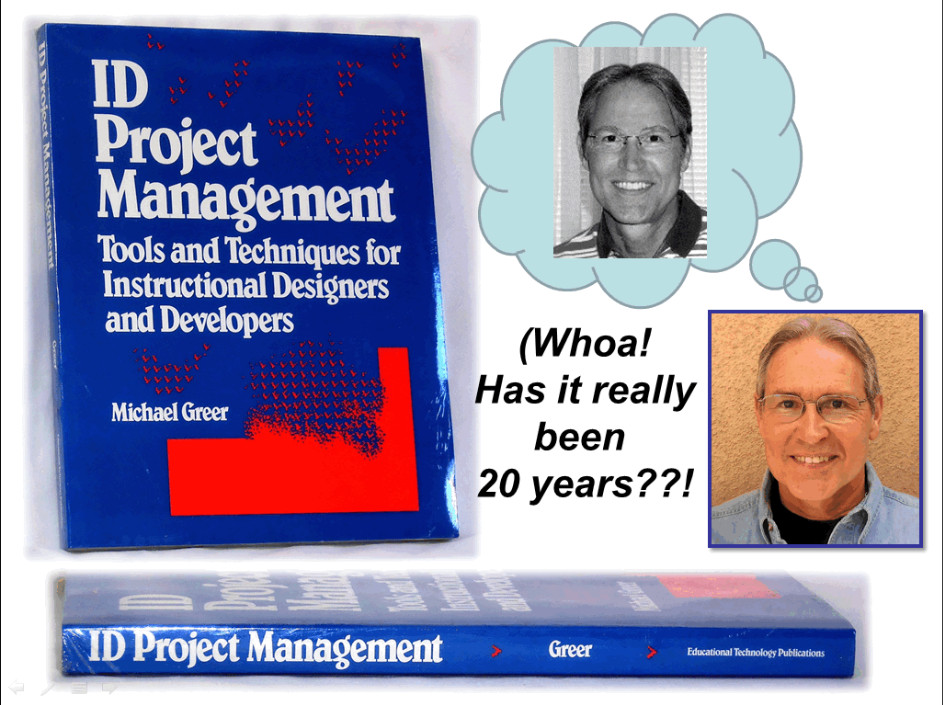
    20th Anniversary PDF Editions of My ID Project Management Book

    2012 was the 20th anniversary of the publication of my first book, ID [Instructional Development] Project Management: Tools and Techniques for Instructional Designers and Developers.

     Every couple of months someone emails me and asks where they can get a copy of this book. I usually tell them that as far as I know the publisher has taken it out of print.

    Then I explain that since it's publication in 1992, I've written & published 5 more PM books. And all of these are "agnostic" -- designed to be used in any industry or any areas of specialization (including instructional design & development).  Then I simply recommend my latest book & support tools (The Project Management Minimalist) instead.

     Still, there are those folks who REALLY push me to help them find the book. For them, and all of you who might be wondering about my ID PM book, I've created a couple of "scanned PDF" versions of this book which you can download.  Note that the "scanned PDF" format has some limitations, such as non-scalable fonts, etc. (Please see the notes below the "Read More" line for details.) Enjoy!

     - - - - - - - - - - - - - - - - - - - - - - -

    Get the Printer-Friendly Version

    Choose the "printer-friendly" version if you intend to print copies of this book on standard, 8 1/2" by 11" pages. Please be advised that this is a "scanned PDF" file. Please read the technical note* below re: formatting.


    - - - - - - - - - - - - - - - - - - - - - - -

    Get the E-Reader Version

    Choose the "e-reader" version if you intend to use this scanned PDF with your Kindle, NOOK, iPad, or computer's PDF reading software. Please be advised that this is a "scanned PDF" file. Please read the technical note* below re: formatting. 


    Best Practice: Understand and Deal with Procrastination


    [This book excerpt is from "Taking Care of Yourself:  Managing Your Priorities, Time, & Energy" in The Project Management Minimalist]
     - - - - - - - - - - - - - - - - - - - - - - - - - - - - - - - - - - - -

     “Procrastination is a mechanism for coping with the anxiety associated with starting or completing any task or decision.” -- Neil Fiore in The Now Habit: A Strategic Program for Overcoming Procrastination and Enjoying Guilt-Free Play 


    I created the chart after reading Neil Fiore’s unique description of how procrastination works…how it is part of a larger cycle of emotions, starting with perfectionism and driven by fear. (What an amazing insight!) Here’s an example of how it works. When you get that big, important project assignment, you are overwhelmed by a sense of perfectionism. This is your big chance and you want to execute it perfectly. This leads to a fear of failure that stops you in your tracks. You procrastinate. After procrastinating for a while, you begin criticizing yourself. The longer this self-criticism goes on, the greater your chances are that you’ll begin to experience anxiety and depression, loss of confidence, and an even greater fear of failure! The only way you can end the cycle is to use what Fiore calls “the now habit.” Fiore recommends applying a set of “replacement thoughts” in order to develop “the now habit.” Specifically, you need to make these replacements:

    • Replace “I have to” with “I choose to.”
    • Replace “I must finish” with “When can I start?”
    • Replace “This project is so big and important” with “I can take one small step.”
    • Replace “I must be perfect” with “I can be perfectly human.”
    • Replace “I don’t have time to play” with “I must take time to play.”
    The theme here, as you can see, is to begin thinking of yourself as being empowered to take on the project on your own terms. I’ve highlighted the “… take one small step” replacement thought above because it is echoed by many other great thinkers as the best way to deal with fear. As Ralph Waldo Emerson says: “Do the thing you fear and the death of fear is certain… Do the thing and you will have the power.” Then there’s this from Dr. Susan Jeffers in Feel the Fear & Do It Anyway: “The only way to get rid of the fear of doing something is to go out and do it… Even if you just take a baby step or two… you need to act… Experience a small success, overcome a little piece of your fear, and build on that.” (My bold added. -MG) And finally from David J. Schwartz in The Magic of Thinking Big: “Here’s something to remember: Actions feed and strengthen confidence; inaction in all forms feeds fear. To fight fear, act. To increase fear — wait, put off, postpone… Jot that down in your success rule book right now. Action cures fear.” (My bold added. -MG)

    The point is that action, in itself, is empowering. It energizes you. You aren’t frozen in place anymore, procrastinating. You are in motion, pushing through your own fear, even if it’s to take a small baby step toward completing that complex project. One empowering thing you can do to remove the fear that keeps you procrastinating, is to simply trust your judgment. I discussed this topic in some detail earlier in The People Stuff part of this book. The main thing to remember here is that you have a perfectly trustworthy “internal wisdom filter” that will generate plenty of good judgments for you if you get out of your own way and simply trust it.


    (Above: How your “internal wisdom filter” works and why you can trust your judgment! For much more on this topic, see the section above titled: “Trust Your Judgment,” as well as my supporting podcast. – MG)

      Summarizing, to deal with procrastination, you need to:
    • Let go of perfectionism. (Be human, create something that may be flawed, and understand that most projects involve lots of polishing and revision. So it’s okay if this particular iteration isn’t perfect!)
    • Meet fear of failure head on and take some action, no matter how small, that moves your toward your goal.
    • Recast your internal “self-talk” so that you are empowered, not victimized.
    • Trust your judgment. You’ve earned wisdom through your experiences!
    - - - - - - - - - - - - - - - - - - - - - - - - - - - - - - - - - - - -

     [This book excerpt was from "Taking Care of Yourself:  Managing Your Priorities, Time, & Energy" in The Project Management Minimalist]

    Free E-Book: One Simple Thing to Improve Projects or PM (An Anthology)


    Last November I invited visitors to this web site and other PM discussion sites to share “one simple thing...” that could improve projects and/or project management (PM). Many smart people with lots of different PM experiences took the time to think about, then respond to, this invitation.  This free e-book anthology is a collection of these responses...

    It includes:
    • Full-blown articles by guest bloggers published on this website
    • Comments by this website's visitors
    • Comments posted on LinkedIn's “PMChat” group
    • Comments posted on this discussion on Focus (Focus.com).
    My heartfelt “Thanks!” to all of you who were kind enough to create and share your thoughtful responses to this challenge!  And I hope you find this anthology to be a thought-provoking and valuable resource.


    What I Learned About Managing Passion from Helping "Occupy the Rose Parade"


    [Originally published on Jan 10, 2012 on my Inspired Project Teams website. NOTE: You can take this article with you! Download a specially-formatted Kindle, NOOK, or PDF version.]

    When a project team is trying to create something great – something that excites and captures the imagination of creators and stakeholders – something that could change the world – then that project’s team leaders have to figure out how to handle the passion that swirls all around that vision. Specifically, project leaders need to answer these questions:
    • How do you harness passion without snuffing it out? … or without having it blow up in your hands because you squeezed it a little too hard trying to contain it or bend it to your will?
    • How do you synchronize the differing passions of individual team members and then embed these as a unified force in the finished product, so that its energy can crackle and arc like a lightning bolt across the chasm that separates your team from your customers?
      I realize, after having experienced Occupy The Rose Parade (OTRP) first hand, that the OTRP leadership team seems to have answered these questions brilliantly. In this article, I’m going to share what I observed and what project managers everywhere can learn from OTRP about managing that most precious of project resources: passion.

      Occupy the Rose Parade: How I Got There

      On January 2, 2012 (Rose Parade day) I dragged myself out of bed at 4:00 a.m., drove to downtown Los Angles’ Union Station, then caught the Gold Line train to Pasadena. (FYI: On the day of the Rose Parade you really don’t want to be driving around Pasadena. So, “Thanks, LA Metro system!” for my car-free ride to the parade!) Stepping off the train, I began walking to the Norton Simon Museum following directions provided by the OTRP website.

      The website had invited everyone to meet there and organize for a nice, friendly, non-disruptive, city-approved mini-parade that would begin at the tail end of the official Rose Parade. Sounds simple enough, right? Just go to the Norton Simon Museum (where I’d been before, though in the daylight and by car!) Unfortunately, in the dark of the early morning, I must have misread a street sign or something. After a somewhat confused, 20-minute walk, I ended up at the LA Sheriff Department’s Rose Parade Command Center. (Whoops!) I bid the on-duty deputies “Good Morning!” and was quickly on my way! 

      Eventually, after wandering around for about an hour, stepping over parade-goers in sleeping bags and getting directed and redirected by locals, I found myself stalled out completely just a couple of blocks from the OTRP rally point at the museum. Turns out the Norton Simon was near where TV camera crews & VIPs were gathering. And it had (just minutes before my arrival) been safely tucked away behind miles of that yellow “Police Line, Do Not Cross” plastic tape. To get through, you had to show a ticket! (I had none.)

      So that was it, it seemed! Game over! Discouraged, I headed back toward the main parade route to figure out what to do next.  Fortunately, just a couple of blocks away from where I had been stopped by the police, I saw some Occupy banners and headed straight for them. Walking up to their bearers, I introduced myself, asked what I could do, and was immediately invited to help hold up a huge banner that said: “Corporate Money Out of Politics: Now!” (That’s me, at the end of the red arrow in the photo below.)


      Whoo hoo! I had arrived! The OTRP folks had staked out this claim hours ago. It was about 40 feet of curb right on Colorado Blvd., the main parade route. Better yet, for our purposes, it was right across from a bleacher full of cameras and reporters. Our job would be to maintain a gently challenging presence here during the official parade. Then, when our OTRP parade arrived, with its Occupy Octopus and walking U.S. Constitutions and human floats, we would simply step off the curb, join our main group and carry our banners along the parade route to the final destination: Pasadena City Hall.  In the meantime, there was nothing to do now but wait and watch the parade and maybe chant or yell a little, as the spirit moved us.

      So… Who Were These People? And What Were They Doing? 

      So. There I was. Standing there holding a banner with this eclectic group of OTRP strangers for more than an hour before the official parade began. I didn’t know anyone. I had never met any Occupy activists before this moment. I just knew that I was full-tilt angry and disgusted and wanting change because [insert your favorite political rant here]. And so I had joined them. While we stood there waiting, we introduced ourselves. I was relieved to learn that most of the people who stood with me hadn’t known each other before that morning.  They had just showed up, full of passion, to see if they could get involved. 

      There was the father of four grown kids from Orange County, the multiple-degreed post-grad Political-Science student who held forth with articulate political justifications and historical perspective, the good natured but determined retirees, the college semi-grads who dropped out due to lack of funds or simply quit when they realized there were no jobs to be had for grads or non-grads, the 12-year-old girl who was there with her dad, the college kids on their bikes. They spoke Spanish and English and a couple of other languages I couldn’t place. And they were African-American and Mexican and White and Asian and other subtle racial blends that I didn’t recognize. Some had grey-hair or white beards, while some had dreadlocks and some were bald. And some were pierced and tattooed and covered with face paint. You get the idea. A wide variety of people made up this little ad-hoc Occupy The Rose Parade “project” team.


      What united them was their passion – an anger – an outrage that the deal they had been promised by the educational institutions (work hard, earn good grades, learn plenty of skills and you'll be rewarded with a job, meaningful work and an independent middle-class life) or the promises made by financial institutions (“Invest here! We’ll make your life savings grow for you!” or, worse, “Sure… You can afford that mortgage!”) – that these deals & promises had somehow been broken or stolen by complicated “Gotchas!” hidden in the fine print. One-by-one they'd arrive, introduce themselves briefly or sometimes just skip the introduction entirely, then ask: "What can I do? You got any extra signs or banners? Are there brochures or papers I can pass out? Should I be yelling or chanting something?"

      Interestingly, there was no specific individual who answered every question posed by each new arrival. There was no leader. I even found myself, complete Occupy newbie that I was, answering some of these questions and helping someone assume a useful role on my newly-adopted team. Somehow someone among us always spoke up and provided guidance or handed over a sign or pamphlet or suggested a place to stand and a way to engage the message. We all wanted the same thing: To succeed in delivering a message with as much force and clarity as possible. So the answers just seemed to bubble up out of the group, cooked up by some magical interaction between these passionate people and the crowd and the imagined media audience we were trying to address.


      After the Rose Parade began, without overt instructions from anyone, we began reacting to various floats and other parade entries by yelling out rhythmic, rhyming chants or simple slogans. Seeing an entry from a financial institution or global mega company, we’d yell, “Hey, Hey. Ho Ho. Corporate Greed has got to go!”  When politicians passed by, it was, “Tell me what democracy looks like! This is what democracy looks like!” And this was usually followed by something like “Overturn Citizen’s United…” or “Corporate Money Out of Politics.”  When some Wisconsin-based entries went by, someone started yelling, “Impeach Scott Walker! Impeach Scott Walker!” and we all joined in to underscore that message.

      The verbiage we let loose wasn’t always confrontational, however. We’d see floats and marching units from volunteer organizations, equestrian clubs, police or veterans’ organizations etc. and start yelling, “We are the 99 per cent! You are the 99 per cent!” followed by “The people, united, can never be defeated!” And then we’d applaud and cheer them. This frequently got a smile and a “thumbs-up” from someone who was marching among them.

      On a couple of occasions one of the younger Occupy kids would react to a flag-twirling young girl in tights or a short skirt with a wolf-whistle or a provocative comment. When this happened, the kid was immediately tapped on the shoulder by a more level-headed comrade and told: “Hey… Cool it! You’re representing the whole Occupy movement here.


      Show her the respect she deserves!” And he’d quickly comply.

       Eventually the end of the official Rose Parade passed by, our OTRP entries arrived and we stepped in to join the group to its final destination at City Hall. Along the way we were pleasantly surprised that so many Rose Parade attendees had remained to see what we were up to. Many of them waved. Some cheered in solidarity. I walked to the sidelines and smiled and asked people my age to join us “for their kids and grandkids.” Nobody told me to do this. It was entirely spontaneous and it just made sense to me. So I did it. Taking this initiative, I was able to increase our ranks by 15 or 20 people whom I recruited along the way.

      One of these folks – an ancient, but decidedly angry lady – joined in while riding in one of those “Hover-Round” carts! Throughout our “We the People…” parade, we were gently guided by OTRP core team members in special green-fluorescent “99” vests.


      They helped us avoid obstacles, including a couple of piles of horse manure left by the equestrian units! They also adjusted our pace to meet the needs of various news media, handicapped volunteers, and traffic. They were low-keyed – almost invisible.  Yet they maintained safety and order. Eventually we arrived at City Hall, where we milled around waiting for the entire parade group to assemble before hearing from various guest speakers and encouragers.

      And Did This “Project” Succeed?

      The results of Occupy The Rose Parade were clear. An estimated 5,000 to 7,000 Occupy Activists had assembled at one of the largest, most-televised events of the year. And they had achieved the simple goal of raising consciousness about the effects of corporate money in our political process. And, in particular, how the “99%” have been displaced and rendered irrelevant by this money.


      A thousand cameras and microphones and reporters from news entities around the world had asked for, and received, spontaneous interviews from our ranks. And we had replied to these media people at will, unscripted, imbued with the passion that brought us together. And this passion was transformed into all manner of news stories, photo essays, and blog posts. All this came about without any arrests or violence of any kind. So I’d call that a success!

      Managing All That Passion

      OK. Enough about our fun. What are the project management (PM) lessons that I learned from this experience? At the beginning of this article, I posed these questions that every project manager must answer if she wants to create world-changing, creativity-infused results:
      • How do you harness passion without snuffing it out? … or without having it blow up in your hands because you squeezed it a little too hard trying to contain it or bend it to your will?
      • How do you synchronize the differing passions of individual team members and then embed these as a unified force in the finished product, so that its energy can crackle and arc like a lightening bolt across the chasm that separates your team from your customers?
        Here’s how OTRP addressed these questions. Here are the “management” mechanisms I witnessed that kept the Occupiers’ passions alive, while providing guidance and enough boundaries for their actions to ensure success:

        Motivational Support and Logistical Information Available 24/7

        The Occupy the Rose Parade website was (is) not all that pretty. But it is loaded with information that can fan the flames of any discontent you might have with the status quo. The front page answers the cosmic question “Why occupy the Rose Parade??” by presenting short fact-filled motivational videos, articles, and more from great thinkers, artists, comedians, politicians, etc. This stuff is both eclectic and effective.

        I’m sure there were many others who, like me, began this journey by simply visiting the site out of idle curiosity and ended up so highly motivated that they enlisted in the cause. (Note: Some time after my first visit to this site, I had begun to have second thoughts about getting involved. So I revisited the site and reviewed the media collection related to “Why…” and became re-motivated!)


        The site was also the source of vital logistical information. On the weeks prior to the parade, the website presented page after page of detailed info about:
        • How you could be involved (different “stages” and events, different roles, etc.)
        • Where and when to show up
        • Specific, detailed directions and maps
        • Recommended train lines, what to do with your car, what to bring, etc.
        • Broad guidelines re: messaging, signage, etc.
        Here’s an example of the power of this info-rich website: It made the strongest possible case for my involvement. Yet did so in an exciting, entertaining way. And it was very clear about the logistical “how” of my involvement. I could return to the site over and over again, 24/7, to clarify and strengthen my plans for participating. They had made it all very easy! In short, this website encouraged and amplified my passion by deepening my own “Why” through the media presented and linking me to great minds who shared my position. At the same time, I was motivated by the easy, step-by-step “How” that allowed me to creatively visualize with crystal clarity my specific involvement. (I came away feeling: “Yeah! I can do this!”)

        Broad Goals & A Framework for Participating; No Micromanaging

        The OTRP website provided general themes related to the message we were trying to spread. And, while the Occupy leadership had planned for a couple of key entries with specific messages (the Octopus, the Constitution, etc.), the website suggested we each consider the broad themes and create our own signs with our own, personally-meaningful messages. That’s incredibly empowering! I was being encouraged to share some of myself, to reach inside and put my heart on the line!

        At the same time, the Occupy leaders were quite open about the various opportunities for involvement. You could create signs, help organize speakers and guests, become a green-vested “guide,” or take any other role your imagination could envision. If it would support the broad message and work within the general guidelines (safety, legal, etc.), then almost any participation was welcomed. By being empowered to select my job within the event, I could make a contribution that I could personally get excited about.

        Self-Managing Teams

        As I described earlier, I was part of an ad-hoc group of Occupiers positioned along the parade route. I hadn’t planned to join them. But when I arrived eager to contribute they put me to work. I was older than those who welcomed and guided me. But to them, I was simply another resource, quickly evaluated, judged trustworthy, and subsequently empowered to help share the message. And I observed several more team members as they were acquired in this same manner. As noted earlier, this team moved fluidly from one chant to another, judging appropriateness based on the latest stimuli offered up by the parade.

        Occasionally, somebody’s chant or behavior was rejected, gently but quickly, by an ad hoc quorum of fellow team members who swooped in to persuade the offender to curb his misplaced enthusiasm. This group shared a vision. They were guided by the broad OTRP goals as articulated at the website. And they were permitting nothing to interfere with our alignment with these. I honestly believe that had there been a specific, clearly-identified leader, most of us would have felt somehow diminished. The self-managed team, in reality, encouraged passionate, yet appropriate and self-managed, expression. No one wanted to be the one who ruined things for the rest of the group!

        Immediate Communications Through Social Networking

        OK. To be honest, I can only speculate about this. But from what I could tell, many of our team were in continual contact with other teams and with the people who would eventually appear as the “We the People…” procession. I’m not sure exactly what tools they used, but judging from their conversations and responses, I’m fairly certain they were tracking their comrades and the conditions at other venues through Twitter, Facebook, texting, and more. Occupy The Rose Parade existed as a real-time, self-managing organization, courtesy of the internet and the genius “light touch” of those who were behind this event.

        In Sum: It’s All About the Passion! So let’s summarize the management tools and strategies that I experienced by helping to Occupy The Rose Parade:
        • Passionate, smart people – individual citizen activists – whose smoldering coals of anger and discontent had been turned into the flames of passion by a carefully-curated collection of media that was available 24/7 on the web to recruit newbies (or to revive the enthusiasm of the Occupy veterans who might become discouraged).
        • A nearly-invisible team of organizers who gently and deftly leveraged all that passion by providing just enough of a framework for organized, coordinated effort (i.e., strength in numbers!), while encouraging free, unique expression of the broader vision by individuals.
        • Self-managed teams, empowered by all of the above to take independent action and move toward the goal. (Thus empowered, our enthusiasm and sense of having “skin in the game” could only increase!)
        • A not-so-pretty, but highly effective website that provided plenty of essential logistical information, thus eliminating confusion and obstacles that could put out the fires of passion.
        • The social media tools in everybody’s pockets (texting, Facebook, Twitter, etc.) to allow real-time adjustment to rapidly-changing conditions, thus ensuring a smoother operation.
        Each of the above enhanced the passion of the individual activists (think “project team members”) precisely because they allowed the administrative stuff… the management stuff… to become nearly invisible. It simply wasn’t noticeable! And when it did appear, it was welcomed as a tool to help keep things moving. If you can employ these or similar tools on your next project that requires an inspired, creative team, you are bound to be successful in keeping their passion alive.

        Click here to see Photo Album: Occupy the Rose Parade